

 Login / Register
 RHS Award Winning Varieties
 Quality UK Grown Plants
 12 Month Guarantee
 100% SSL Secured Shopping
You have probably heard of mycorrhizal fungi (or rootgrow™, the RHS endorsed brand we sell here at Pomona Fruits), but wondered exactly what it is and how it can benefit your new fruit plants?
What is mycorrhizal fungi?
A mycorrhiza is the term for a beneficial relationship between a specific type of fungi and the roots of a plant. The fungi grow on, or in many cases, into the plant’s roots forming a connection, the fungi then grow out into the soil forming a large secondary root system of fungal roots (hyphae). This system collects water and nutrients and brings them back to the plant. In exchange the fungi receive sugars from the plant which are used as an energy source for growth. In this way both the plant and the fungi gain benefits. Fungi which are able to form this relationship are called Mycorrhizal Fungi.
How can mycorrhizal fungi benefit my plants?
Plants which have these special fungal partners can establish more successfully and the relationship improves their resilience to stresses such as drought and low nutrient availability in poor soils. These fungi explore a greater volume of soil than roots can reach alone, helping plants access water and nutrients, such as phosphorus. This is a natural relationship which takes time to form but you can speed it up by applying mycorrhizal fungi to the roots of your plants at the time of planting. Rootgrow™ is a blend of different mycorrhizal fungi species on a mineral carrier. These can be sprinkled into the planting hole, patted onto the rootball or made into a dip and applied to bare roots just before planting. As the right species of fungi are close to the roots the relationship begins to form in just a few weeks. Think of it as a way to give your plants the best possible start.
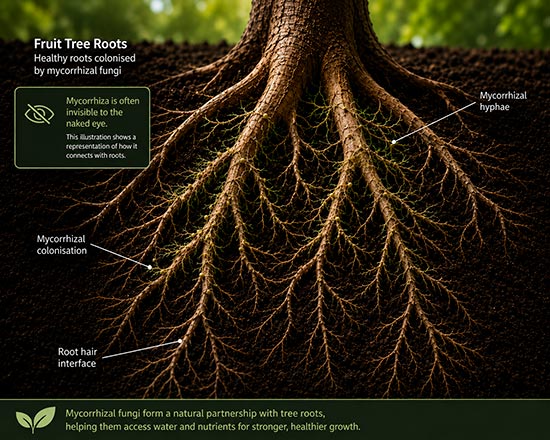
Illustration of a fruit tree root system showing healthy roots colonized by mycorrhizal fungi
Different types of mycorrhizal fungi
Different mycorrhizal fungi work best with different plant types. The team at rootgrow™ have created a general blend in their standard product which works with most plant species including nearly all fruit plants. There are some exceptions through. There are a group of ericaceous (acid loving) plants which have a special type of mycorrhizal fungi – these are rhododendrons, heathers, cranberries and blueberries. It’s important to note that it is just these families, and not all acid loving plants, as many associate with the standard blend of rootgrow™ e.g. Camelias and Acers.
For cranberries and blueberries we have a special blend including two types of ericoid mycorrhizal fungi, look out for rootgrow™ ericoid when buying these plants. Because not all acid loving plants need this special species the mix also contains some of the standard mycorrhizal fungi too so can be used for all your fruit planting needs.
What if I want to treat a plant with mycorrhizal fungi post planting?
Although it’s always best to apply rootgrow™ directly to the roots, at the time of planting, sometimes you may have a plant already in the ground which you want to treat. One option is to try a biofertiliser with added mycorrhizal fungi (e.g. Afterplant Biofertiliser for Trees and Shrubs). These contain a low concentration of mycorrhizal fungi which will form associations with surface roots, along with a range of nutrients. Alternatively consider a companion planting, adding a new plant nearby and treating this with rootgrow™. For example planting a few treated bulbs near an established apple tree. The mycorrhizal fungi will associate with the treated bulbs first and then the fungal roots (hyphae) will spread out into the soil and join to the apple trees’ roots too. In nature this process can link many different plants together, sharing water, nutrients and also information – leading to the nickname the wood wide web.
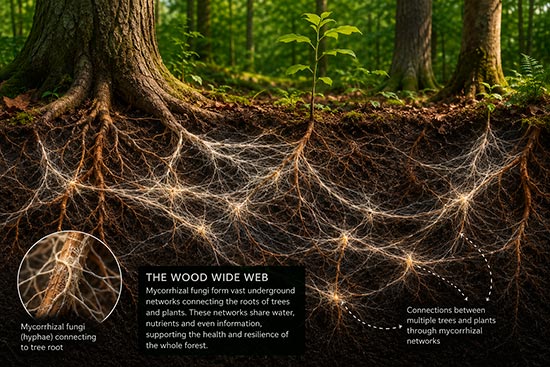
The Wood Wide Web