

 Login / Register
 RHS Award Winning Varieties
 Quality UK Grown Plants
 12 Month Guarantee
 100% SSL Secured Shopping
Plums, gages, damsons and mirabelles are some of the most rewarding fruit trees you can grow in a British garden, and with the right care they’ll produce delicious fruit year after year. Knowing when to prune plum trees is probably the single most important thing you can do to keep them that way.
Gages, damsons and mirabelles are specific types of plums. They all share the same growth habits and, crucially, the same pruning rules and from hereon in we will refer to them all as “plums”. Unlike apples and pears, plums have specific timing requirements that really do matter. Get it right and you’ll have a healthy, productive tree for decades. Not sure where to start? This guide covers everything from when to prune a plum tree and how to go about it, through to what to look for and how to keep things on track season after season.
When to Prune a Plum Tree
Timing matters when it comes to stone fruit like plums because of silver leaf (Chondrostereum purpureum), which is a fungal disease that enters trees through fresh pruning wounds. Its spores are most active in autumn and winter, which is why summer is your seasonal window. Prune between late May and August and the tree naturally produces a gummy resin that actively resists spore entry, a neat piece of natural self-defence.
For most established garden plum trees, June or July is the sweet spot. The first flush of growth is done and there’s still enough warmth in the season for cuts to heal cleanly before the weather turns. When to prune a plum tree comes up a lot as a question, and the honest answer is that summer is nearly always right. Wounds to the tree heal faster at this time of year and spore counts are far lower, both working in your favour. The same timing applies whether you’re growing plums, damsons, gages, or mirabelles. All share the same pruning calendar, so the guidance here covers the whole family.
Silver leaf is primarily a concern for commercial orchards, where long rows of the same variety create ideal conditions for spread. In a typical garden it rarely takes hold, though some varieties (Victoria in particular) are more susceptible than others. The timing rule is simply good practice and following it keeps your tree in the best possible shape.
Does the Age of Your Tree Change Anything?
Yes, slightly. Young plum trees respond well to formative pruning in early spring just as the buds are beginning to break. Because cuts at this stage are small and the wood is fresh, wounds heal quickly and the silver leaf risk, while not zero, is considerably lower than in autumn or winter. Summer pruning remains the safest default once the tree is established
You’re also making decisions that will shape how the tree grows for years to come, so it’s worth taking your time and thinking about the structure you want. Once the tree is established and producing fruit, that early spring window closes and midsummer becomes your main annual pruning time instead.
When to Prune Victoria Plum Trees
Victoria is the plum most gardeners reach for first, and it’s easy to see why. Self-fertile and reliably heavy-cropping, it’s been a garden staple for well over a century and remains the most popular plum variety in the UK. The good news is that pruning a Victoria plum is no different to pruning any other plum tree. The same principles apply, and everything you need to know is covered in detail below. One thing worth knowing about Victoria specifically is that it sits towards the more susceptible end of the scale when it comes to silver leaf, so sticking to the summer pruning window is particularly worthwhile. Stick to it and you’ll have very little to worry about.
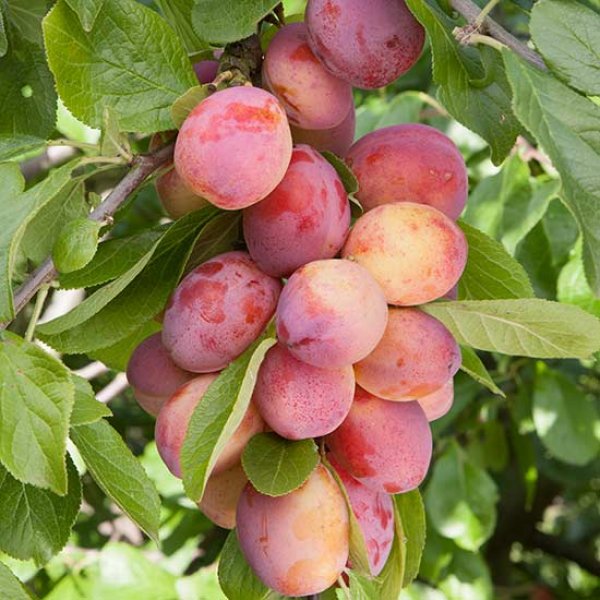
How to Prune a Plum Tree
Now that you know when to prune plum trees, we can move onto the how. Understanding how to prune a plum tree is pretty straightforward, as they tend to require the same precise attention that apple and pear trees require.
Most garden plum trees are trained into one of three forms: an open bush for free-standing trees, a pyramid for a compact and productive standalone specimen, or a fan for trees grown against a wall or fence. Cordons are a great option too, particularly if space is tight. They can be grown at a 45 degree angle or vertically using wires to support them against a sunny wall or fence. Alternatively, if planted away from a wall they can be grown vertically using a stake to support them instead.
The form you’re working with shapes how you approach every pruning session.
Pruning a Bush Plum Tree: the Open Vase Method
The open bush creates a goblet-shaped canopy (wide and open at the centre), with light and air circulating freely through the branches. Think of it like an umbrella: strong, evenly spaced ribs spreading outward, with nothing crowding back towards the handle.
Start, always, with the three Ds: dead, diseased and damaged wood. These come out first, regardless of the time of year as clearing them immediately improves the picture. From there, remove branches that cross or rub (the friction creates wounds that make the tree vulnerable), then stand back and assess the overall shape. Anything growing back into the centre of the canopy is worth removing to keep that open structure intact.
If the tree has become congested over time, thinning some of the older fruiting spurs encourages fresh, productive new growth to take their place. Plums don’t need the same annual reduction as apples, and if significant reshaping is needed, spreading it across two or three years gets excellent results. Taking too much off in a single season tends to trigger a flush of soft watershoots, so a measured approach always pays off.
How to Prune a Plum Tree Trained as a Fan
A fan-trained plum against a warm, south or west-facing wall is one of the real pleasures of a kitchen garden. Productive and surprisingly space-efficient, these trees make every square foot count.
The pruning principle is simple once you understand the goal: maintain the fan framework by tying in new growth where it’s needed and remove any shoots growing directly towards or away from the wall. After fruiting, cut back the shoots that have carried fruit to a strong young sideshoot lower down. This keeps the fan regularly furnished with fresh, productive wood. In the third week of July, shorten branch leaders to around 20cm (8in), cutting to a downward or outward-facing bud, and side branches to about 15cm (6in).
Pruning a Pyramid Plum Tree
The pyramid is a brilliant form for gardeners who want a compact, productive tree that stays at a manageable height. It’s shaped like a Christmas tree with a central leader at the top with branches that get progressively longer as you move downwards, letting light reach every level of the tree. Plums on St. Julien ‘A’ rootstock work particularly well in this form.
Pruning a pyramid plum follows the same summer timing rules as any other form, with July being the ideal month. The goal each year is to maintain that tapered shape by shortening new branch growth to keep the upper branches shorter than the lower ones. In the third week of July, cut back new branch leaders to around 20cm (8in) and any sideshoots to about 15cm (6in), always pruning to a downward or outward-facing bud. The central leader should be shortened annually until the tree reaches your desired height, at which point it can be cut back each year to keep it in check.
As with the open bush, remove any dead, crossing or congested wood first, and take out watershoots promptly as they appear.
Pruning a Plum Tree: What Tools are Needed?
Bypass secateurs (Felco are a tried-and-tested choice) for cuts up to your thumb’s thickness.
A pruning saw for anything thicker than your thumb.
Methylated spirits to wipe blades clean between trees, particularly if you’re working across several in one session.
If you’re stocking up on kit, our gardening accessories section includes rootgrow™, stakes, ties and the RHS Growing Fruit book, which is a comprehensive guide to growing fruit. Don’t forget our expertly produced fruit feed, which contains vital nutrients and trace elements required for growth
Plum Tree Pruning Diagram
Getting familiar with the anatomy of your tree makes every pruning session more effective. A plum tree pruning diagram is useful here, particularly when you’re first getting to grips with the structure. The diagram below covers the main branch types you’ll encounter and what to do with each.

One detail that’s particularly worth understanding is how plums produce their fruit. Unlike apples, which fruit on older spur systems, plums crop on wood that is one to two years old. The aim is always to maintain a steady supply of young, productive growth, removing spent older wood to make room for new. It’s a rhythm that, once you’re in it, becomes instinctive.
After Pruning: Feeding, Aftercare and What to Watch for
A little aftercare in the weeks and months following pruning keeps the tree in great shape and sets it up well for the coming season. Plus, it really doesn’t take much to reap the benefits.
A balanced spring feed gives the tree the nutrients it needs to channel into fruiting growth. A general-purpose granular fertiliser works well, as does a good layer of well-rotted compost around the base. Our Fruit Feed is specially formulated for exactly this purpose, with a balanced NPK ratio suited to all top fruits. Water during dry spells, particularly while the tree is still establishing.
On wound paints:
the RHS no longer recommends applying them as standard, preferring to let cuts heal naturally. For trees where silver leaf has been a recurring issue, applying a proprietary wound sealant to fresh cuts is a sensible precaution
Spotting Silver Leaf
If you do notice a silvery sheen developing on the leaves of a branch, cut into it and check for a dark brown stain in the wood. It’s very easy to manage silver leaf if you catch it early enough, which is why awareness is essential. Remove the affected branch back to clean, unstained tissue, seal the cut, and dispose of the prunings rather than composting them.


Watch for Bacterial Canker
Bacterial canker is another condition worth keeping an eye out for. It tends to show up as sunken, oozing patches on the bark, or as dead buds and shoots in spring that fail to break into leaf. If you spot it, prune back to healthy wood well below the affected area, seal the cut, and bin the prunings rather than composting them. Prune plums in dry summer weather when possible, as the warm, dry conditions make it much harder for the disease to take hold.
Choosing the Right Plum Tree for Your Garden
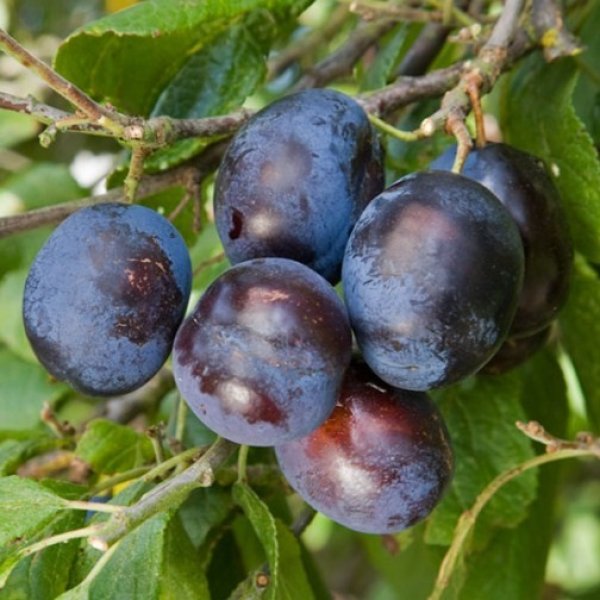
Self-fertile varieties are the easiest starting point. Victoria is the obvious choice for most gardens due to their positive reputation, but Opal is a brilliant early-season alternative while Marjorie’s Seedling extends the season right into autumn. All three crop well without needing a pollination partner, so are straightforward and rewarding in equal measure.
If you’re after something a little different, damsons are a wonderful choice. They make exceptional jam and fruit pies, and the trees themselves are famously tough and undemanding. Merryweather is a reliable self-fertile variety that suits most gardens beautifully.
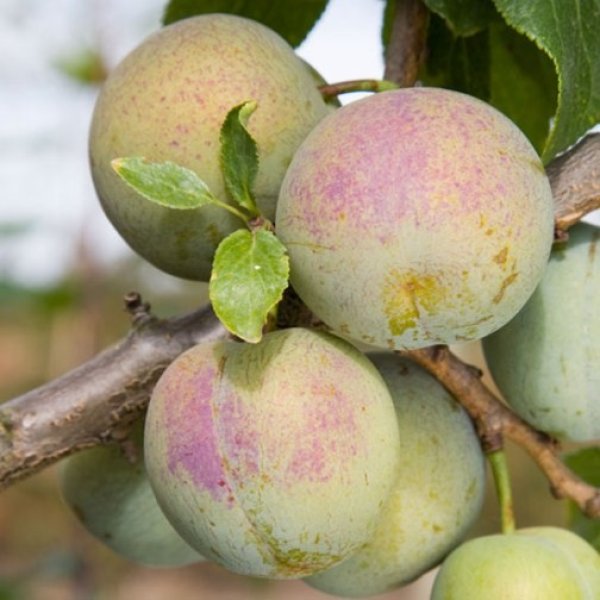
Gages, on the other hand, offer intensely sweet, honey-rich fruit that tastes like summer in every bite. Cambridge Gage is a classic self-fertile variety and well worth growing if you can give it a warm, sheltered spot to bring out the best of that extraordinary flavour.
Mirabelles (cherry plums) are small and gloriously sweet. Less commonly grown in the UK than they deserve to be, they’re prolific croppers and brilliant for eating fresh, preserving, or baking. If you’ve never tried growing them, they might just become your new favourite.
Short on space? Our cordon plum trees are a practical and productive answer, compact enough to grow just 60cm (3ft) apart and more than capable of delivering a generous harvest.
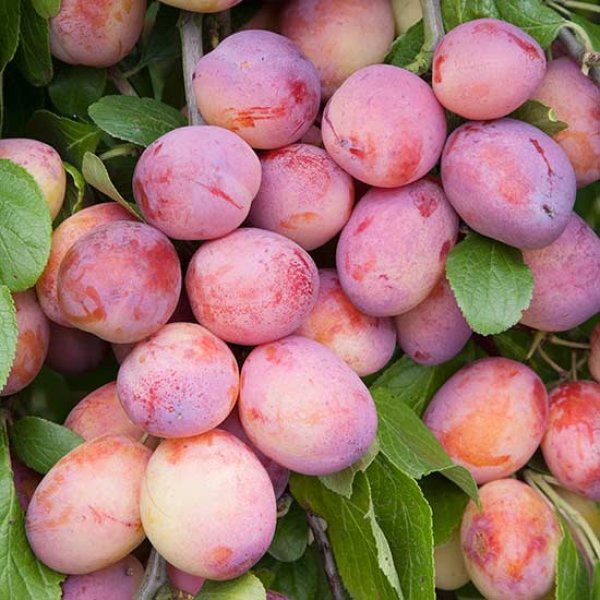
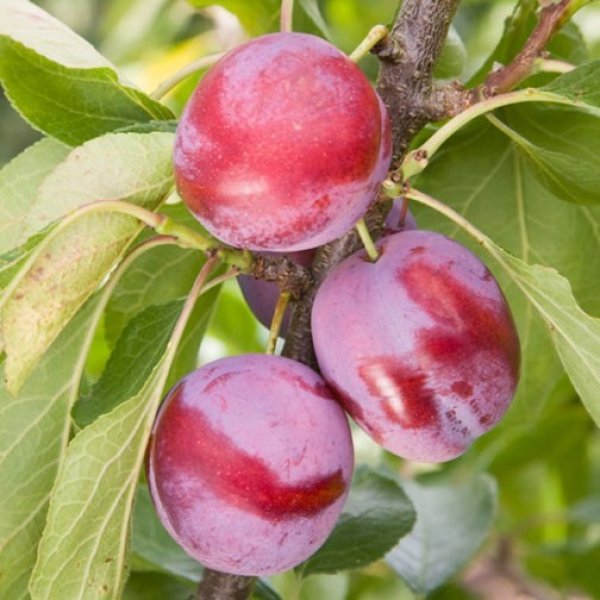
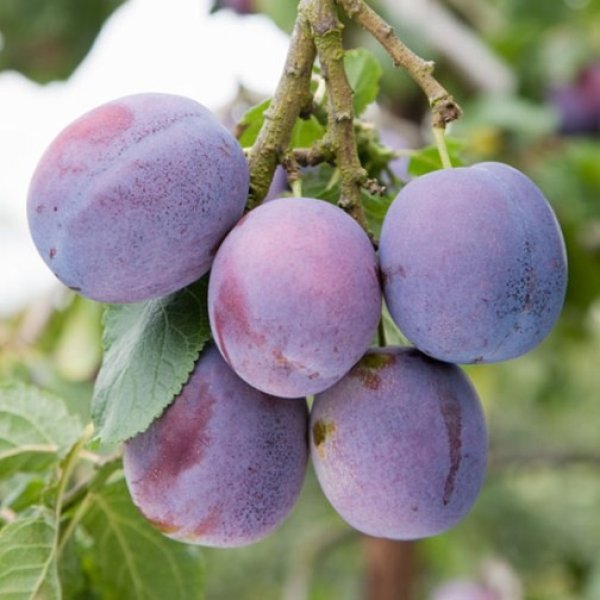

Growing your own fruit is one of the many pleasures of gardening, and with a plum tree the rewards come reliably and often. If you have questions about varieties, rootstocks or anything pruning-related, we’re always happy to help via our free advisory service.